

TIG and MIG are the two most common welding methods in industrial fabrication, and choosing between them affects the speed, cost, strength, and finish of your finished product. They are not interchangeable. Each has clear strengths, and using the wrong one can mean a weaker joint, a slower job, or a poor-looking weld.
This guide explains how TIG vs MIG welding compare, the pros and cons of each, and how to decide which is right for your project.
What Is MIG Welding?
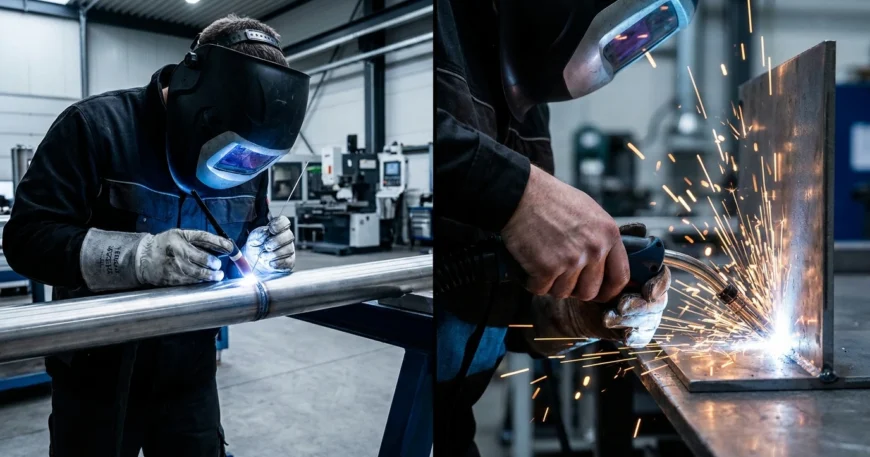
MIG (Metal Inert Gas) welding feeds a continuous wire electrode through the welding gun, which melts to join the metal while a shielding gas protects the weld. Because the wire feeds automatically, MIG is fast, easy to learn, and well suited to high-volume work.
MIG welding is strong on:
- Speed and high production output
- Thicker metals and heavier structural work
- Long welds and repetitive fabrication
- Lower cost per weld on large jobs
What Is TIG Welding?
TIG (Tungsten Inert Gas) welding uses a non-consumable tungsten electrode to create the arc, while the welder adds filler metal by hand. This gives the welder precise control over the weld, producing clean, accurate, and attractive joints.
TIG welding is strong on:
- Precision and fine control
- Thin metals and delicate joints
- Clean, high-quality, visible welds
- Stainless steel and hygienic applications
TIG vs MIG: Head-to-Head
Here is how the two methods compare on the factors that matter most in fabrication:
- Speed: MIG is faster; TIG is slower but more controlled.
- Precision: TIG wins for fine, accurate work.
- Material thickness: MIG handles thick metal better; TIG excels on thin metal.
- Finish: TIG produces cleaner, better-looking welds.
- Cost & output: MIG is more economical for large, high-volume jobs.
- Skill required: TIG needs more skill and time; MIG is quicker to master.
Simple rule: Choose MIG when speed, thickness, and volume matter. Choose TIG when precision, thin metal, and a clean finish matter. Many fabrication projects actually use both, depending on the part.
Which Should You Choose for Your Project?
The right method depends on what you are building:
- Structural steel, frames, heavy fabrication → MIG, for speed and strength.
- Stainless steel vessels, hygienic equipment, visible joints → TIG, for a clean, precise finish.
- Thin sheet metal and detailed parts → TIG, for control without burning through.
- High-volume production runs → MIG, for efficiency and lower cost.
In practice, an experienced fabrication workshop will select the method (or combination) that gives your part the best balance of strength, finish, and cost.
Need Precision Fabrication for Your Project?
Hanif & Sons provides expert TIG and MIG welding and full fabrication services for industrial and commercial clients.
Request a Quote