

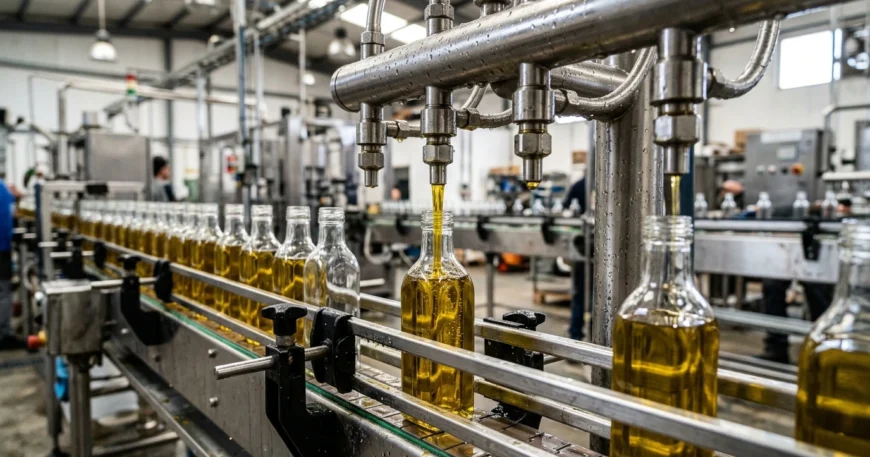
Filling is one of the final and most important stages of production, and the machine you use directly affects accuracy, speed, and waste. But not all fillers work the same way. A machine built for thin liquids will struggle with a thick cream, and filling by volume is very different from filling by weight. Knowing the main types of liquid filling machines makes it far easier to choose the right one for your product.
What Is a Liquid Filling Machine?
A liquid filling machine accurately transfers a set amount of product into bottles, jars, drums, or other containers, ready for sealing. The best type for any job depends mainly on the product's viscosity, the container, the accuracy required, and how fast the line needs to run. Here are the main types.
1. Overflow Fillers
Overflow fillers fill every container to the same visible level rather than the exact same volume. This gives a consistent look on the shelf, even if containers vary slightly in size.
Best for:
- Thin to medium free-flowing liquids
- Clear bottles where a consistent fill level matters
- Water, juices, and light cosmetic liquids
2. Gravity Fillers
Gravity fillers hold product in a tank above the containers and release a timed, set volume that flows down by gravity. They are simple, reliable, and cost-effective for the right products.
Best for:
- Thin, free-flowing liquids
- Water-like products and light oils
- Budget-friendly, consistent volume filling
3. Piston Fillers
Piston fillers use a piston to draw in a precise volume of product and push it into the container. Because they fill by positive displacement, they handle thick products with ease.
Best for:
- Thick and viscous products
- Creams, sauces, gels, and pastes
- Products with particulates or chunks
4. Pump Fillers
Pump fillers use a pump to move product into the container, and the pump type can be matched to the product. This makes them versatile across a wide range of viscosities.
Best for:
- A wide range of viscosities, thin to thick
- Products that need flexible, adjustable filling
- Lines that handle multiple product types
5. Net-Weigh Fillers
Net-weigh fillers fill each container to an exact target weight rather than a volume, using built-in scales. This gives very high accuracy, which is valuable for costly products.
Best for:
- High-value products where exact weight matters
- Chemicals, and premium or bulk products
- Filling into drums and larger containers
Quick guide: Thin liquids → gravity or overflow filler. Thick products → piston filler. Mixed viscosities → pump filler. Exact weight needed → net-weigh filler. Match the filler to your product first, then to your speed.
How to Choose the Right Filler
- Viscosity: the single most important factor, thin versus thick.
- Accuracy: by level, by volume, or by exact weight.
- Container: bottle, jar, drum, or pouch.
- Speed: manual, semi-automatic, or fully automatic to match output.
Answering these before you buy ensures the filler suits your product and your production rate, avoiding waste, spillage, and inaccurate fills.
Need a Filling Machine for Your Product?
Hanif & Sons designs and manufactures custom filling machines for liquids, creams, and powders in SS304 and SS316.
Request a Quote