


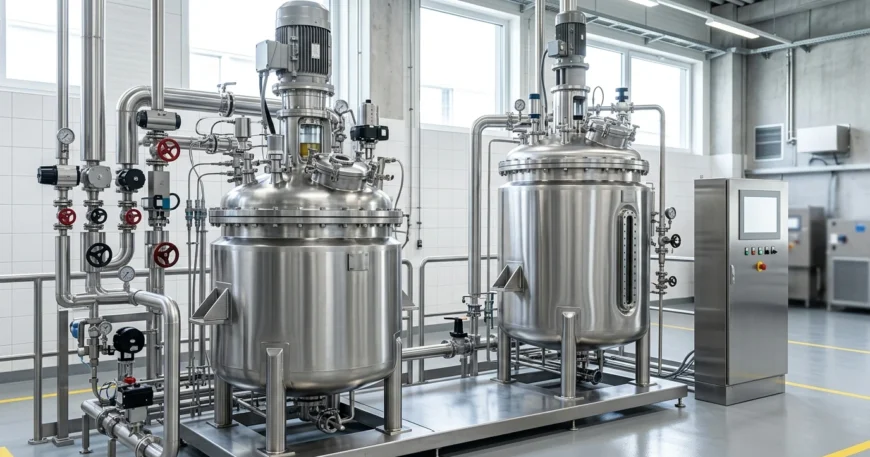
Reactors and fermenters look similar and are often confused, but they are built for very different processes. One drives a chemical reaction, the other grows living organisms. Getting the difference right matters, because the wrong vessel can compromise safety, product quality, or an entire batch. Understanding reactor vs fermenter makes it clear which one your process actually needs.
What Is a Reactor?
A reactor is a vessel engineered to carry out a chemical reaction under carefully controlled conditions. It manages temperature, pressure, and mixing so that the reaction inside proceeds safely and produces a consistent result. Reactors are usually built from stainless steel and can be jacketed for heating or cooling and fitted with agitators to keep the contents uniform.
Reactors are used for:
- Chemical reactions in controlled conditions
- Pharmaceutical and chemical manufacturing
- Processes needing precise temperature and pressure control
- Mixing and reacting ingredients into a finished product
What Is a Fermenter?
A fermenter, also called a bioreactor, is a specialised reactor designed to grow living micro-organisms such as bacteria, yeast, or cultures. Because it deals with living things, a fermenter must stay sterile and hold precise, gentle conditions so the organisms survive and produce the desired result. It often includes aeration, careful temperature control, and contamination-free design.
Fermenters are used for:
- Growing micro-organisms and cultures
- Pharmaceutical and nutraceutical production
- Food and beverage fermentation processes
- Any process where sterility and biological control are critical
Reactor vs Fermenter: The Key Differences
Both are controlled vessels, but they differ in what happens inside and how tightly conditions must be managed:
- Process type: A reactor drives a chemical reaction; a fermenter grows living organisms.
- Sterility: Fermenters require strict sterility; general reactors may not.
- Control: Fermenters need gentle, precise conditions to keep organisms alive.
- Aeration: Many fermenters supply air or oxygen; most reactors do not.
- Relationship: A fermenter is a specialised type of reactor.
The simple way to remember it: A reactor makes a chemical reaction happen. A fermenter keeps living organisms happy while they do the work. Every fermenter is a reactor, but not every reactor is a fermenter.
Shared Features
Despite their differences, reactors and fermenters share a lot. Both are precision vessels, usually stainless steel, that rely on:
- Accurate temperature control, often through a jacket
- Reliable agitation to keep contents uniform
- Hygienic construction and clean welding
- Instrumentation to monitor and control the process
This is why both are engineered to order around the specific process they serve, rather than bought off the shelf.
Which One Does Your Process Need?
The choice comes down to what happens inside the vessel. If you are running a chemical reaction, you need a reactor engineered for the right temperature, pressure, and mixing. If you are growing cultures or organisms, you need a fermenter with sterile design and precise biological control. When a process combines elements of both, the vessel is designed specifically to meet those exact needs.
Need a Reactor or Fermenter for Your Process?
Hanif & Sons designs and manufactures custom reactors and fermenters in SS304 and SS316 for precise, hygienic processing.
Request a Quote
Comments (4)
David Parker
November 11, 2021Lorem ipsum dolor sit amet, consectetur adipiscing elit, sed do eiusmod temp incididunt ut labore et dolore magna aliqua Quis ipsum suspendisse
Obila Doe
November 11, 2021What sort of men would think it is acceptable to subject to this level of brutality and violence? an attack like thiop.
James Weighell
November 11, 2021Lorem Ipsum is simply dummy text of the printing and typesetting industry. Lorem Ipsum has been the industry’s standard dummy text ever since the 1500s, when an unknown printer took a galley of type and scrambled
James Weighell
November 11, 2021It is a long established fact that a reader will be distracted by the readable content of a page when looking at its layout. The point of using Lorem Ipsum is that it has a more-or-less normal distribution of letters, as opposed to using ‘Content here, content here’, making it look like readable English.