

What Is a PLC?
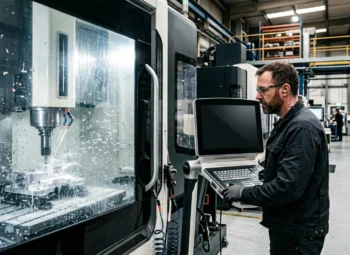
A PLC, or Programmable Logic Controller, is a rugged industrial computer that directly controls machines and equipment. It reads inputs from sensors, runs the control logic it has been programmed with, and switches outputs like motors, valves, and actuators, all in real time and in milliseconds.
The PLC is the part that actually makes the machine do things. It is the hands-on controller on the factory floor.
A PLC handles:
- Real-time control of machines and equipment
- Reading sensors and switching outputs
- Running the automation logic reliably, without a screen
- Fast, repeatable, dependable machine operation
What Is SCADA?
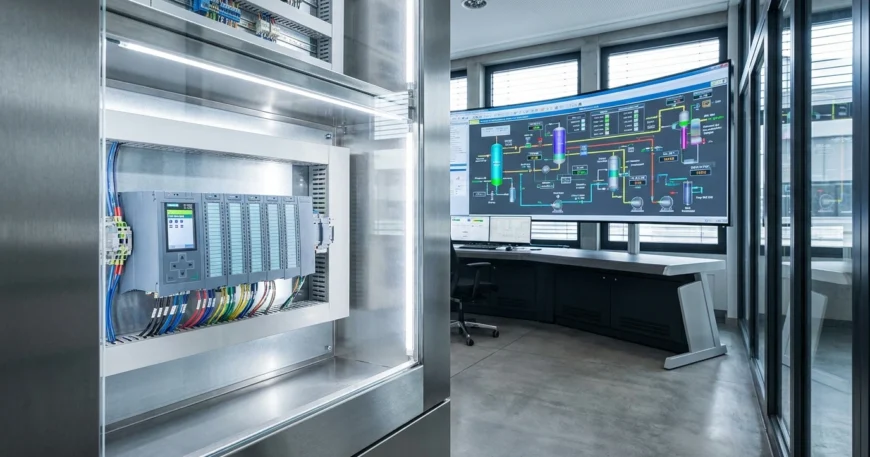
SCADA stands for Supervisory Control and Data Acquisition. It is a software system that sits above the PLCs and gives operators a complete view of the process. Through a SCADA screen, an operator can monitor live readings, see alarms, record data over time, and change settings, often for an entire plant from one control room.
SCADA does not control the machines directly. Instead, it supervises the PLCs that do.
SCADA handles:
- Monitoring the whole process from one screen
- Collecting and logging data over time
- Displaying alarms and warnings to operators
- Letting operators supervise and adjust from a central point
PLC vs SCADA: The Key Differences
The simplest way to remember it: the PLC controls, and SCADA supervises. Here is how they compare:
- Role: PLC controls machines directly; SCADA monitors and supervises.
- Type: PLC is hardware on the floor; SCADA is software in the control room.
- Speed: PLC works in real time; SCADA works at the supervisory level.
- Scope: A PLC runs a machine; SCADA oversees many machines or a whole plant.
- Data: PLC executes logic; SCADA records, displays, and reports data.
Easy way to remember: The PLC is the worker doing the job on the machine. SCADA is the supervisor watching all the workers from the control room and keeping the records.
How They Work Together
In most real automated systems, PLC and SCADA are used together. The PLCs run the individual machines, and SCADA connects to those PLCs to give operators one central view of everything. The operator watches the line on the SCADA screen, and if a setting needs changing, SCADA passes that instruction down to the PLC, which carries it out.
This layered setup is what makes a modern plant both reliable and easy to manage: dependable real-time control at the machine level, and full visibility and data at the supervisory level.
When to Use Each
- Single machine or simple process → a PLC, often with a small HMI screen, is usually enough.
- Multiple machines or a full production line → add SCADA for central monitoring and control.
- You need data logging, alarms, and reports → SCADA provides this on top of the PLCs.
- You need remote or control-room supervision → SCADA is the layer that makes it possible.
Planning an Automation Upgrade?
Hanif & Sons provides PLC programming, SCADA integration, and control panel design to automate your production line.
Frequently Asked Questions
What is the difference between PLC and SCADA?+
A PLC (Programmable Logic Controller) is the hardware that directly controls machines in real time, while SCADA (Supervisory Control and Data Acquisition) is the software system that monitors and supervises the whole process from a screen. In short, the PLC does the controlling and the SCADA does the watching and reporting.
Do PLC and SCADA work together?+
Yes, and they usually do. In most automated setups the PLC controls the machines while SCADA collects data from one or more PLCs, displays it to operators, logs it, and lets them adjust settings. They complement each other rather than compete.
Can you have a PLC without SCADA?+
Yes. A single machine can run on a PLC alone, often with a small HMI screen for basic control. SCADA becomes valuable when you need to monitor, coordinate, and record data across a larger plant or multiple machines from one central place.
Is SCADA a replacement for a PLC?+
No. SCADA does not replace a PLC. SCADA is the supervisory layer that sits above the PLCs, giving operators visibility and control over the process, while the PLCs continue to do the actual real-time machine control underneath.
When should I use SCADA in my factory?+
SCADA is worth adding when you run several machines or a full production line and need central monitoring, data logging, alarms, and remote control. For a single standalone machine, a PLC with an HMI is often enough.