

Buying an industrial mixer is a significant investment, and the wrong choice is expensive to fix. A mixer that cannot handle your material properly leads to poor product quality, wasted batches, and early replacement. The good news is that choosing well comes down to a handful of clear factors. This guide walks through how to choose the right industrial mixer for your product.
Start With Your Material
Everything begins with the material you are mixing. Its viscosity, or thickness, is the single biggest factor in choosing a mixer. Thin liquids, dry powders, and thick pastes all behave completely differently and need different mixing actions.
- Thin liquids need agitators or high-shear mixers.
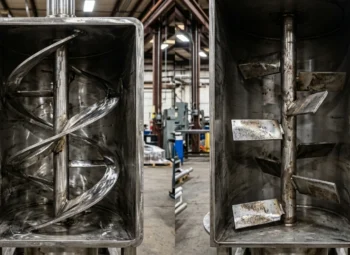
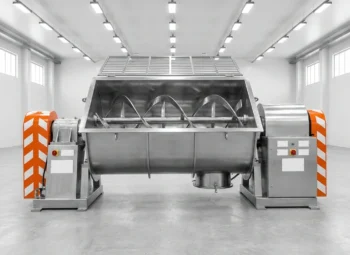
- Dry powders need ribbon blenders or paddle mixers.
- Thick pastes and gels need planetary or high-torque mixers.
Get the material right first, and the mixer type quickly narrows down.
Consider Your Batch Size
The mixer and its vessel have to match your production volume. A mixer that is too small will not keep up with your output and may overload, while one that is too large wastes energy and money. Knowing your typical and maximum batch size ensures the mixer is sized correctly from the start.
Define the Result You Need
Not all mixing goals are the same. A simple blend is very different from a fine, uniform emulsion. Ask what "properly mixed" actually means for your product:
- Do you just need ingredients combined evenly?
- Do you need a fine, smooth, lump-free texture?
- Do you need to keep solids suspended in a liquid?
The required result points directly to the right mixing action and intensity.
Factor In Hygiene and Standards
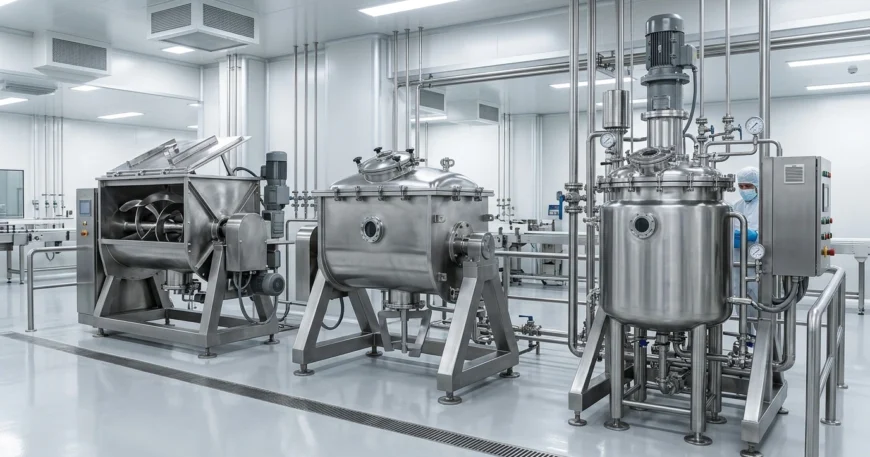
If you are producing food, beverages, or pharmaceuticals, hygiene is not optional. The mixer should be built from the correct stainless steel grade, usually SS304 or SS316, with clean, crevice-free finishes and, where needed, compliance with GMP and food-grade requirements. Overlooking this leads to contamination risk and regulatory problems.
Match to Production Volume
Finally, think about how much you produce and how often. This decides whether you need a manual, semi-automatic, or fully automatic setup, along with features like speed control, timers, and heating or cooling. A low-volume operation and a high-throughput line have very different needs.
The five questions to answer: What is the viscosity? How big is the batch? What result do you need? How hygienic must it be? How much do you produce? Answer these and the right mixer becomes clear.
Common Mistakes to Avoid
- Choosing on price alone and ending up with a mixer that cannot do the job.
- Ignoring viscosity and picking the wrong mixing action.
- Wrong sizing, either too small to cope or too large to run efficiently.
- Overlooking hygiene requirements for food and pharma production.
- Forcing your product to fit a standard machine instead of matching the machine to the product.
Why Custom Often Wins
Off-the-shelf mixers force your product to fit the machine. A custom mixer does the opposite: it is engineered around your material, batch size, and process, with the right impeller, drive, and features built in. For anything beyond the most standard mixing, a purpose-built mixer usually delivers better results and lasts longer.
Get a Mixer Matched to Your Product
Hanif & Sons designs and manufactures custom industrial mixers in SS304 and SS316, engineered around your exact process.
Request a Quote