


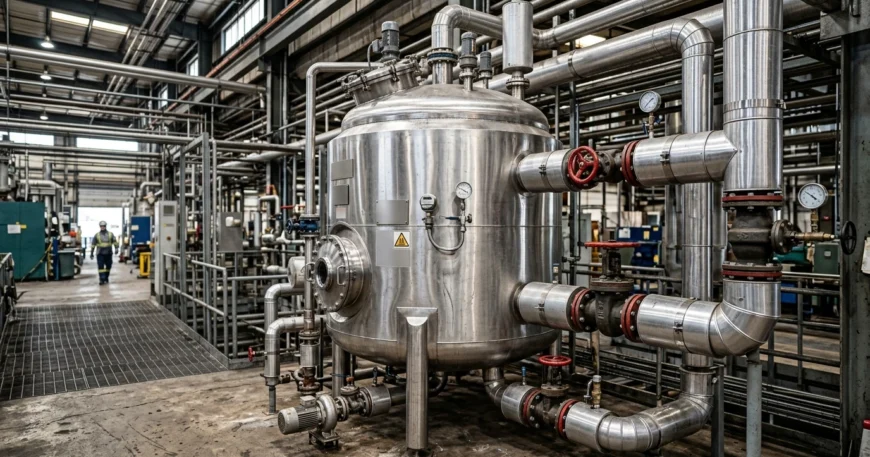
In many industrial processes, controlling temperature is just as important as mixing or storing a product. That is exactly what a jacketed tank is built for. Whether a product needs to be heated, cooled, or held at a steady temperature, a jacketed tank makes it possible, cleanly and precisely. This guide explains what a jacketed tank is, how it works, and where it is used.
What Is a Jacketed Tank?
A jacketed tank is a vessel with a second outer layer, known as a jacket, built around all or part of the inner tank. A temperature-control medium, such as steam, hot water, or chilled water, flows through the space between the two layers. This medium heats or cools the product inside through the tank wall, without ever mixing with it.
The result is precise, even temperature control that a standard single-wall tank simply cannot provide.
How Does a Jacketed Tank Work?
The working principle is straightforward. The jacket creates a sealed cavity around the inner vessel. A heating or cooling fluid is circulated through this cavity, and as it flows, heat transfers through the tank wall to or from the product inside.
- For heating, steam or hot water flows through the jacket and warms the product.
- For cooling, chilled water or a coolant flows through and draws heat away.
Because the temperature medium never touches the product, hygiene and product integrity are maintained, which is essential in food and pharmaceutical processing.
Types of Tank Jackets
Not all jackets are the same. The three main types each suit different needs:
Conventional (Full) Jacket
A full outer shell surrounds the vessel, creating a large space for the medium to flow. Simple, reliable, and well suited to general heating and cooling.
Dimple Jacket
A thinner outer sheet is spot-welded to the vessel in a dimpled pattern. This creates efficient, turbulent flow and good heat transfer while using less medium.
Half-Pipe (Limpet Coil) Jacket
Half-pipe channels are welded in a coil around the tank. This design handles higher pressures and is very effective for demanding heating or cooling duties.
In short: Full jackets are simple and general-purpose, dimple jackets are efficient and economical, and half-pipe jackets handle higher pressure and heavier duties. The right choice depends on your temperature and pressure requirements.
Benefits of a Jacketed Tank
- Precise temperature control for sensitive products and processes
- Even heating or cooling across the whole vessel
- Hygienic operation, since the medium never contacts the product
- Better product quality and consistency, batch after batch
- Versatility, as the same tank can heat or cool depending on the process
Where Are Jacketed Tanks Used?
Jacketed tanks are essential across process industries wherever temperature matters, including food and dairy processing, pharmaceutical manufacturing, chemical production, and cosmetics. They are used for mixing, reacting, pasteurising, crystallising, and storing temperature-sensitive products. Anywhere a process depends on holding the right temperature, a jacketed tank is often the answer.
Need a Jacketed Tank for Your Process?
Hanif & Sons manufactures custom jacketed tanks and vessels in SS304 and SS316 for precise temperature control.
Request a Quote